
When two people on your team stop talking, “just sort it out” doesn’t work.
Imagine two colleagues, Nina and Paul.
They have worked together for two years. Lately, Nina does her part of every project a day or two late. Paul quietly fixes half of it in the evenings after work, and he has stopped speaking up in meetings. Nina thinks Paul is cold and controlling. Paul thinks Nina doesn’t care.
Neither has said any of this out loud.
You are their manager. You see it, so you say what most of us would say: “Can you two please sort this out?”
Two weeks later, nothing has changed. Except now they both know that you know.
I’ve been in all sorts of rooms and situations where people really try their best to mediate conflict. The problem is, they work on the part of the problem they can see, and the part that drives it stays out of view.
The part of the conflict you can see is small
When a conflict looks confusing, I draw this picture. I call it the iceberg of feelings and needs, and it’s inspired by Nonviolent Communication (NVC).
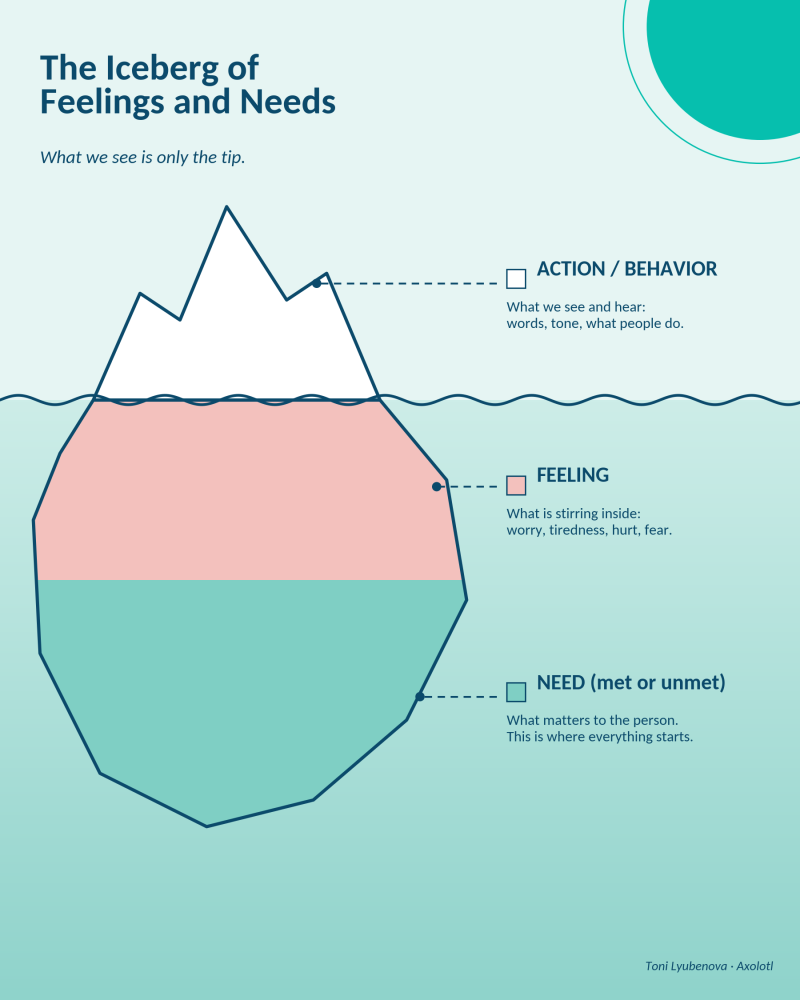
Start with the small white tip above the water. This is what we can see and hear: words, tone, what people do. In our story, Nina hands in her work late. Paul fixes it at night and goes quiet.
Now look below the water. In the middle there is a feeling, shown in pink. It is what is stirring inside the person: worry, tiredness, hurt, fear. Nobody sees it unless someone asks.
At the very bottom, in teal, there is a need. A need is something that matters to the person, and right now it is either met or unmet. This is where everything starts. An unmet need creates a feeling, and the feeling shows up as the behaviour we notice.
Back to Nina and Paul
Let’s guess. Paul, up late redoing work, may feel worried and tired. Underneath, he may need to trust that what leaves the team is solid. Nina, handing in late, may feel overloaded and a bit invisible. Underneath, she may need support, or simply someone asking how she is.
These are guesses, and the conversation is where you check them. But see what already changed. A minute ago you had one cold, controlling person and one careless person. Now you have two people who both care about the work, and who both feel alone with it.
What people ask for and what they need
Ask Nina and Paul what they want, and you’ll hear it straight away. Nina: “Deadlines should be flexible.” Paul: “A deadline is a deadline.” These two sentences cannot both win.
The needs underneath can both be met. Support for Nina and reliability for Paul fit into the same plan. In most conflicts I’ve seen, what people asked for could not fit together, while what they needed could. That’s where the way out usually is.
How to handle conflict in your team: what you can do as their manager
Start with yourself
Before you call anyone, stop and breathe. Ask what is going on in you. Maybe you’re annoyed, or tired of standing in the middle. They will feel whatever you walk in with.
Listen to each of them alone first
Tell both that you’ll do this, so nobody feels talked about behind their back. Then listen, and leave the solving for later. Say back what you heard, including the feeling: “It sounds like you worry about the quality when the work goes out, and you’ve been carrying that alone.” People soften when they feel heard. Often this alone starts to move things.
Pay attention to silence
When someone like Paul goes quiet, he is usually protecting something, and what he protects is often fair. Pushing makes him guard it harder. Making it safer helps him open up.
Give them a simple shape for speaking
When you bring them together, ask each to say four things: what I noticed, how I felt, what I need, and what I’d like to ask. For example:
Paul: “When the drafts arrive late on Wednesday, I worry. I need to know the work is solid. Could we look at it together during the day?”
Nina: “When I hear you’ve been redoing my work, I feel small. I need support, and I’d like to be trusted. Could we agree every Monday on what is most urgent?”
Each of them starts with what they noticed and ends with a request, which means the other can say yes, no, or “let’s adjust it”.
Make sure each person is heard before anyone solves
When Paul speaks, Nina says back what she heard, and then they swap. Protecting this is your main job in the room. Solutions come much more easily afterwards.
A month later
Paul says good morning first. Nina asks what he thinks before she sends her draft. Nothing dramatic happened. Two people were heard, and they found a way of working that suits them both.
Try it this week
Pick one tension on your team. Before you talk to anyone, write down three lines: what you see, what the person might be feeling, and what they might need. Do the same for the other person. That is enough for a first time.
A note
When you manage both people, you are never fully neutral. They know you have power over them. If the tension is old, or you are part of it, bring in someone from outside.
In the next couple of months, I plan to run a free online session on exactly this: real situations, real techniques, live. To hear about it, write to me at axolotl.management@gmail.com.
Toni P. Lyubenova is a qualified mediator, NVC practitioner, founder of Axolotl and co-founder of Creatosphere. She works with NGOs, Erasmus+ partnerships, and civil society organisations across Europe.